
Nov 26, 2026
How to Get Management Buy-In for Safety
By Blaine J. Hoffmann, MS OSHM
To get management buy-in for safety, stop asking leaders to approve your plan and build it with them instead. Learn what they measure every day, such as throughput, quality and cost, and talk about safety in those terms. Then bring them honest numbers, including the risk that's still open, and keep sharing what's working so the support outlasts the leader who gave it.
That answer comes from four episodes of The SafetyPro Podcast, where the talk was less about winning approval and more about partnership.
Why safety needs operations leaders on its side
In Episode 201, a solo episode, Blaine J. Hoffmann described a type of Safety Pro called the architect, who works toward capacity: the organization's ability to do the right thing when the Safety Pro isn't standing there. Part of that work is earning influence with operations leadership. As Blaine put it, you can't build anything you can't fund or schedule, so you need their support.
Blaine also described the technician: the most knowledgeable person in the building, and routinely ignored. The technician aims at being right, and the job, in Blaine's words, pays for being effective. If you can't turn a technical truth into a business decision a plant manager will actually support, Blaine said, nobody cares. The Episode 201 post covers the rest of the modes Blaine named.
Stop asking for a yes
Heather MacDougall, a lawyer and CSP who served as Amazon's worldwide head of workplace health and safety, doesn't like the setup where safety simply asks other departments for approval. On Episode 196, Heather put it this way: "It shouldn't be like, we have to get yes from, you know, dad." The partners should come to the plan together.
That's why Heather wants the strategic plan built with partners across the business at least once a year, with owners for the goals across the organization and a budget that funds the strategy instead of hoping for a yes. The Episode 196 post covers how Heather sets up that plan.
Heather saw it work during the pandemic. Everybody came to the table to talk about protecting people, and engineering and software teams came up with solutions of their own. In Heather's view, that time really elevated Safety Pros.
Speak the business's language, not safety's
Heather's advice is to learn what your partners measure every day and weave safety into it, so safety becomes one shared business value instead of a silo. Blaine, in the same conversation, admitted that Safety Pros sometimes do the reverse. We "drag everybody kicking and screaming over to safety world" and expect them to learn our language.
For Blaine, the change came from understanding why the business is there. Once Blaine understood that, the role got clearer: help the work go efficiently, make sure it can be done again tomorrow, keep costs down, and avoid turnover tied to poor working conditions and injuries. "I play a role in the success of this business," Blaine said, while making no mistake that the business exists for a specific reason.
Leading with the regulations doesn't help either. Blaine tells people new to safety not to convince themselves that their main job is knowing the regulations. As for the Safety Pro who runs around citing regulations by number: "Nobody wants to listen to that person."
Bring numbers leaders can decide with
Alex Paradies of TapRooT said on Episode 198 that most of the time, management is trying to see where things stand so it can plan for the future. "A good data set allows you to make better and more informed decisions." The trouble, in Alex's view, is that bonuses, pay increases and promotions get tied to those measures, so people end up covering for the numbers instead of collecting the best information they can.
In Episode 201, Blaine described the politician: the Safety Pro who knows exactly which numbers get looked at in the quarterly review and manages the metric instead of the risk. What the politician won't accept, as Blaine described it, is that there may still be risk to manage. The honest version says so, says there's a plan, and reports on the work you intend to do and the support you'll need.
When a leader asks for a number, Alex would first ask in what ways they're using it. If it isn't driving decisions, people may be wasting their time making graphs. At the close of the episode, Alex boiled it down to one question: "What's it doing for me and what's it doing for them?" The Episode 198 post covers the case of a leader over many sites who wants recordables week over week.
Get leaders onto the floor
Alex also wants leadership, and people in general, out on the floor. "I can look at graphs all day," Alex said, but getting your hands involved makes a bigger difference than anything else.
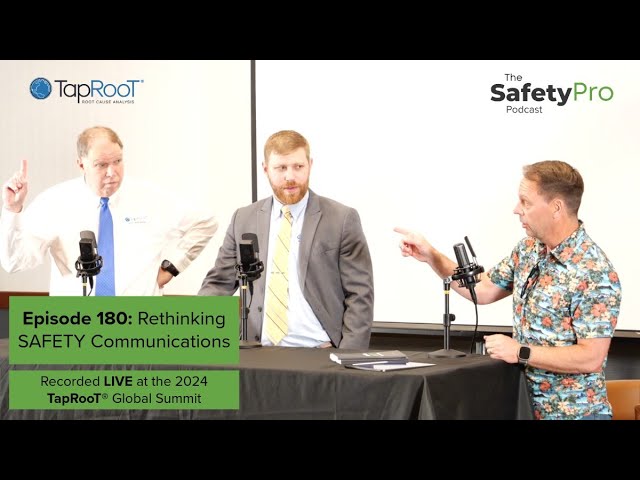
Episode 180 was recorded live at the 2024 TapRooT Global Summit, with Blaine, Mark Paradies of TapRooT and Alex Paradies on the panel. One panelist pointed out that leaders often travel for site audits anyway. Part of a safety communication plan can be working with those leaders ahead of time on the most important safety messages, so they look for them during site visits, even as part of the leadership checklist.
"Hopefully they agree with you," came the reply. Ideally, yes, you have their agreement. "If you've got that alignment within your organization, man, think how powerful that could be."
The Episode 180 post covers the rest of the session, including audits as a way to show what leadership cares about.
Keep the support when leaders change
Early in the Episode 180 session, one panelist warned that a program can succeed and still be at risk. If nobody shares that success with management and the rest of the organization, the next leader arrives with their own ideas and wants to make their own impact. Telling the story of where your organization came from and what the gaps are, that panelist said, "is necessary and it's vital to make sure your program lasts."
Mark Paradies added a caution about the story itself. Good stories can sell management on something with no good product behind it. In Mark's view, what you communicate has to match how the program actually performs.
On Episode 198, Alex looked at leadership changes from the side of the fixes. Over five years, people change jobs and new leaders come in. Alex said we rarely do a good job of handing over the problems we were dealing with and what we did about them. Alex's version of that handoff ends plainly: "Here's the actions we took to solve them. Don't break these."
What to take back to your site
- Set a one-on-one with one operations leader and ask about their goals, their constraints and what they measure every day.
- In your next report to leaders, show the risk that's still open, your plan for it, and the support you'll need.
- Before you send a number up, ask the leader what decision it drives.
- Before the next leadership site visit, give the visitors the most important safety messages to look for.
- Write a short handoff for whoever comes next: the problems you dealt with, what you did, and what not to break.
The full conversations in Episodes 180, 196, 198 and 201 go further into safety messages, planning with partners, honest metrics, and the modes Safety Pros work in. More episodes are on the safety leadership topic page.