
Nov 25, 2026
What an OSHA Attorney Said About Abolishing OSHA in March 2025
By Blaine J. Hoffmann, MS OSHM
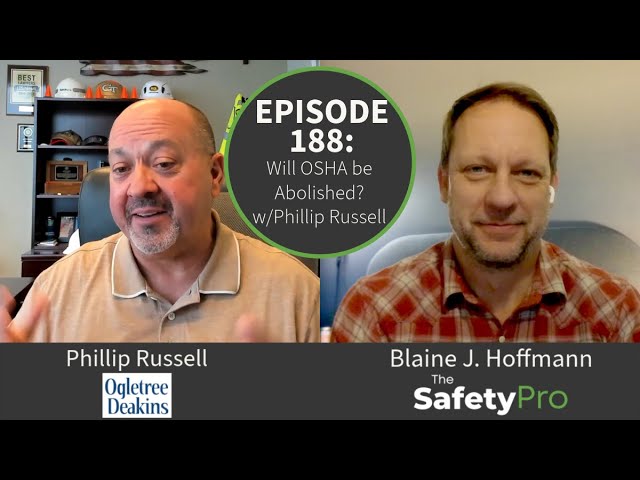
Asked whether a bill to abolish OSHA could make it through Congress, Phillip Russell didn't hedge. "It's got zero chance of passing," Phillip said. Then Phillip pointed to a path to change that runs through the courts.
Phillip is an OSHA attorney at a law firm that works only on labor and employment law for employers. By the time Phillip joined Blaine J. Hoffmann on Episode 188 of The SafetyPro Podcast, which aired in March 2025, Phillip had handled more than 225 fatality cases. "My job is to hold the agency accountable to the law," Phillip said. Some of this may have changed since then.
Why Phillip gave the bill zero chance
Phillip said Arizona Congressman Andy Biggs was introducing the bill for the third time. That wasn't a verdict on the idea itself, Phillip said. It was about the votes. "You have to pass a law to get rid of a law." Even if a bill like that passed the House, it would need 60 votes in the Senate to get past the filibuster, and Phillip didn't see those votes there for this issue.
Blaine said the first version drew no co-sponsors and came with no plan for what would replace OSHA. Phillip recalled the bill being about two sentences long.
Be careful what you ask for at the state level
The bill's idea was to hand safety to the states. Phillip's warning: be careful what you ask for. Florida, where Phillip is based, had no state plan. Would Florida end up with something closer to South Carolina's plan, or closer to California's? And a state's politics can flip 10 or 20 years later, Phillip said, and its plan with it.
Phillip's clients that operate in many states raised another concern: a different fall protection or trenching standard in each state. That would mean, Phillip said, hiring more Safety Pros and building up the safety function.
Still, Phillip was somewhat open to doing more safety work at the state level, and said most of the innovation in new worker protection rules was coming from state plans, not from federal OSHA.
Blaine pointed out that about half the states already ran their own plans, approved by federal OSHA, and could change their rules faster to fit their main industries. The risk Blaine saw was a state shaping its safety rules to attract manufacturing. Blaine could see a blend: a federal minimum, with federal OSHA auditing how each state runs its program. Phillip floated a similar hybrid.
Start with where workers are dying
Asked how OSHA could show the job isn't political, Phillip borrowed an idea from the corporate world: "What's the KPI for OSHA? My answer to that question is fatalities."
If Phillip ran OSHA, the first step would be to open the data and find where workers are dying, by industry, job and employer. Then 100 of the agency's top compliance officers would focus on that and nothing else for two years. Phillip pointed to falls as the number one cause, and to roofing within construction. "There's nothing political about starting with the data."
That was Phillip's central frustration, and what Phillip thought invites bills like this one: an agency whose priorities follow politics instead of the data. To be fair, Phillip said, Republican administrations had done political things too, more in who they didn't target.
The path Phillip said to watch: the courts
Phillip saw a path people weren't paying much attention to. Phillip quoted Justice Clarence Thomas from the year before, when the Supreme Court declined to hear an OSHA case. The justice said the OSH Act may be the broadest delegation of power to an administrative agency in the US Code.
That same year, Phillip said, the Court ended what was called Chevron deference. Judges would no longer defer to an agency's reasonable reading of the law that created it. The next question, in Phillip's view, was whether the OSH Act itself gives the agency too much power, and Phillip was already raising these defenses in contested OSHA cases.
Phillip thought it could take four to six years, but believed the Supreme Court would at some point look at whether the Act is too broad. If so, Congress would go back to the drawing board, and "that's when the debate will really matter."
Who decides whether OSHA got it right
Phillip's message to clients who disagree with a citation: "OSHA doesn't decide if OSHA got it right." In 1970, Phillip said, Congress didn't want OSHA to be both prosecutor and judge, so the law created the Occupational Safety and Health Review Commission. Despite the name, Phillip said, it isn't part of OSHA or the Department of Labor. It's an independent agency with three commissioners and about 25 administrative law judges who hear only contested OSHA citations.
Phillip liked having specialized judges, but understood the argument that judges belong in the courts set up under Article 3 of the Constitution, not in the executive branch, and was raising it for clients too. Through all of it, Phillip kept coming back to one question: what's the most effective way to help workers and employers have a safer place to work?
What to take back to your site
- When you hear that OSHA is about to go away, find out what has actually passed before you change anything.
- If your company works in more than one state, keep a list of which sites fall under a state plan and which under federal OSHA, and where their rules differ.
- Do at your scale what Phillip would have OSHA do: find the jobs behind your most serious injuries, and put your time there first.
- Check how people working at heights are protected, roofs in particular, since Phillip pointed to falls as the number one cause.
The full conversation with Phillip covers more on the Review Commission, the general duty clause, and what Phillip was seeing in OSHA inspections at the time.