
Sep 28, 2026
The Naloxone Mandate Nobody's Talking About Yet
By Blaine J. Hoffmann, MS OSHM
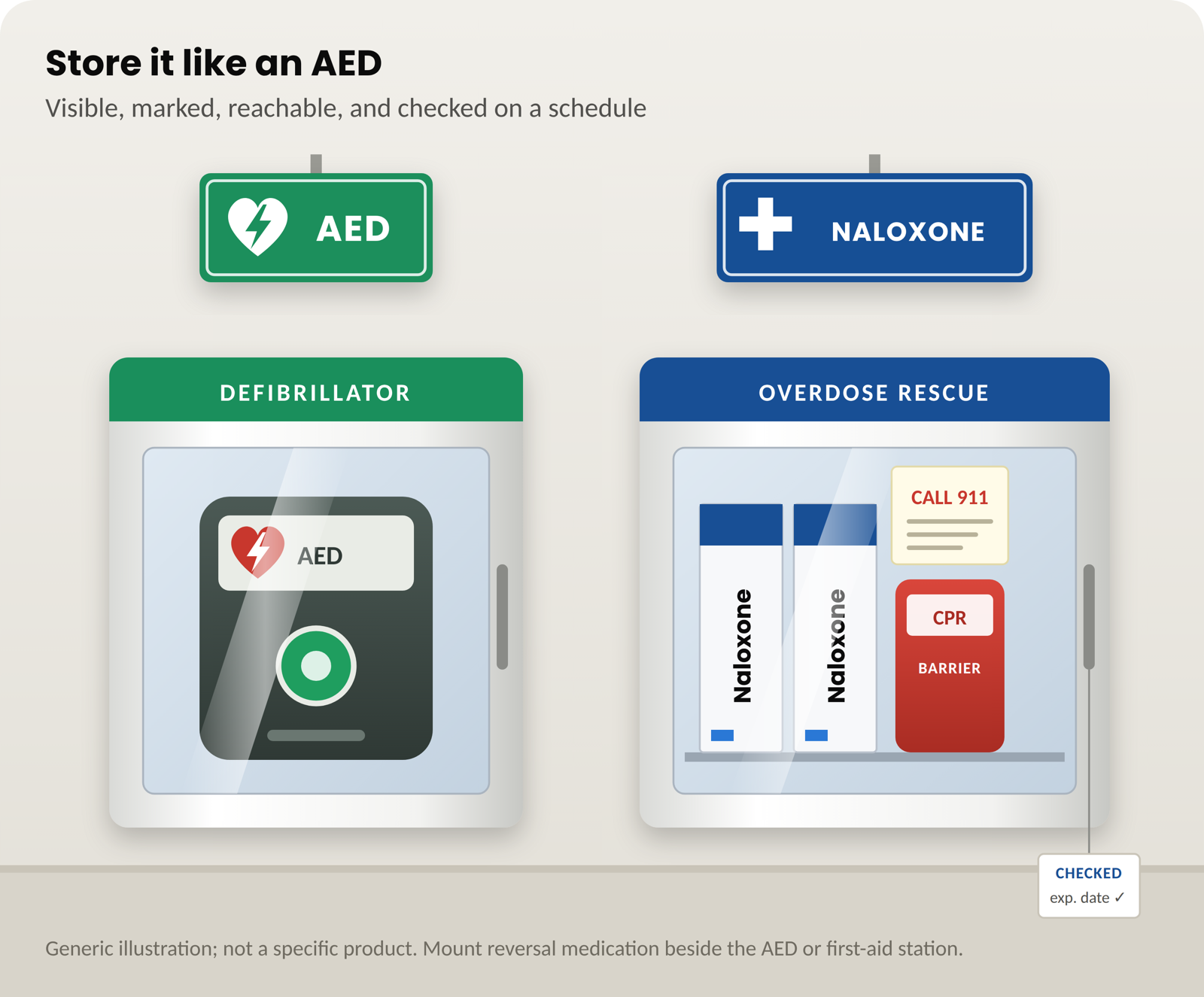
Every safety pro I know keeps a running list in the back of their head: things we all see coming but haven't gotten around to building yet. For a lot of you, opioid overdose response just moved to the top of that list. On September 24, 2026, OSHA published new guidance telling employers to stock and treat naloxone the same way they treat an AED: visible, accessible, ready before anyone needs it. Less than three months later, on December 13, 2026, New York's opioid antagonist law takes effect, turning that guidance into a requirement for many of the state's private employers. California is on the same road, with its own 2028 deadline.
If your first aid program still treats overdose as somebody else's problem (EMS, the hospital, HR after the fact), consider this your nudge to stop waiting. Below is what actually changed, what the numbers say about why it matters, and what to do about it before a regulator, or worse, a funeral, makes the decision for you.
The Numbers Nobody Wants to Say Out Loud
Workplace overdose deaths aren't confined to big cities or a handful of risky industries. They show up everywhere, and the trend line should bother every safety leader who looks at it.
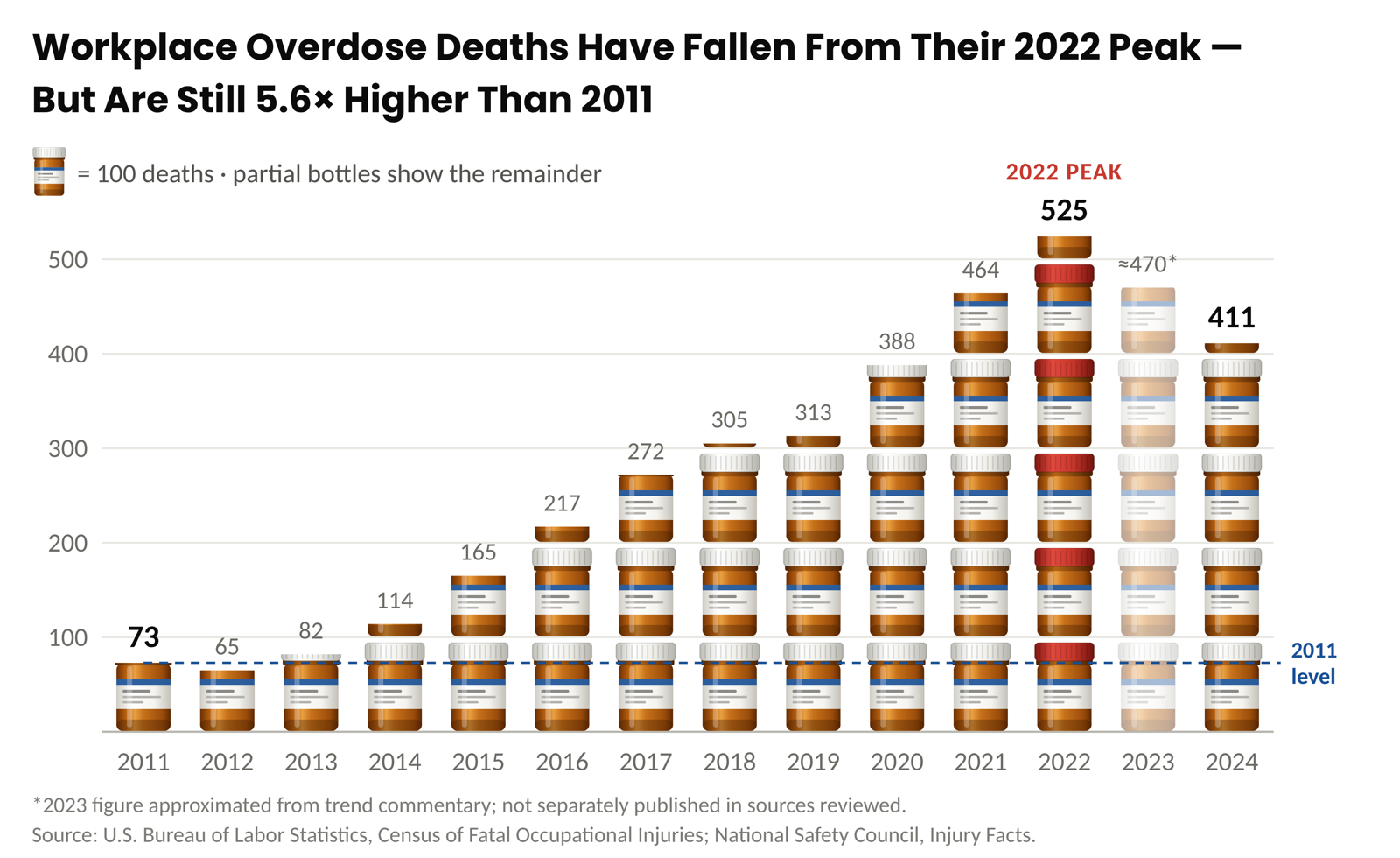
In 2011, the Bureau of Labor Statistics counted 73 unintentional workplace overdose deaths. By 2022, that number reached 525, a 619 percent jump in eleven years, driven almost entirely by fentanyl working its way into the illicit drug supply. The good news, such as it is, deaths have dropped for two straight years, down to 411 in 2024. The bad news: 411 is still more than five and a half times where we started, and a decline from the peak isn't the same thing as a problem solved.
Break that 2024 total down by substance, and the opioid connection is hard to miss.
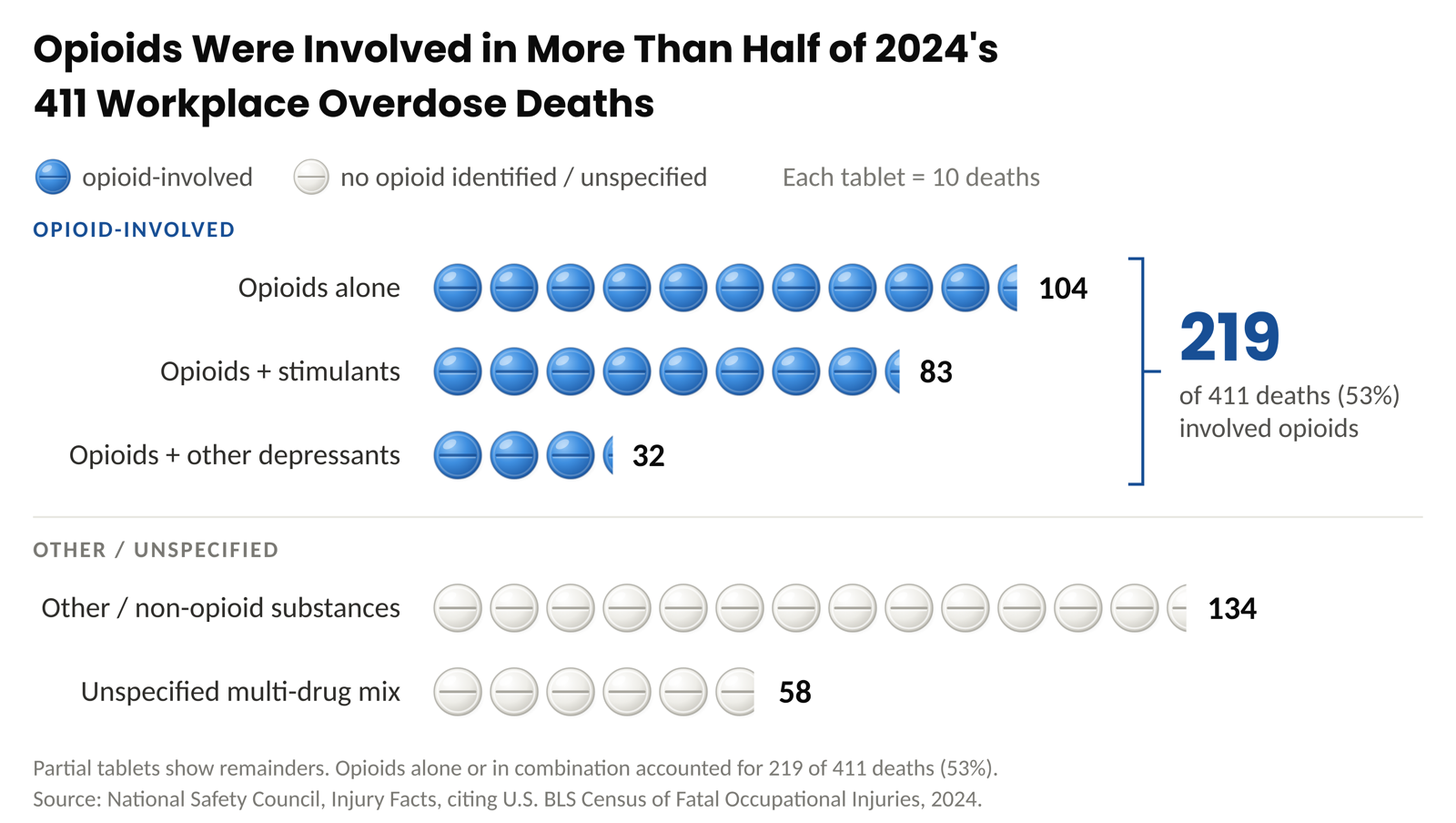
Opioids, alone or mixed with something else, were involved in 219 of the 411 workplace overdose deaths recorded in 2024. That's 53 percent. This isn't a hazard confined to a handful of high risk trades. It turns up in construction, transportation, warehousing, hospitality, and manufacturing, because it follows people, not job titles.
What OSHA's New Guidance Actually Says
OSHA's fact sheet, Opioid Overdose Rescue with Reversal Medications (OSHA 4519), is voluntary. There's no new standard behind it, no new citation category, no enforcement teeth yet. But don't confuse voluntary with optional to ignore. OSHA guidance has a habit of becoming the baseline that General Duty Clause citations, and plaintiff's attorneys, point back to a few years down the road. Treat this as your early warning shot: the moment to get ahead of it, not the moment to file it away and forget it.
Here's the guidance boiled down to what matters on the floor:
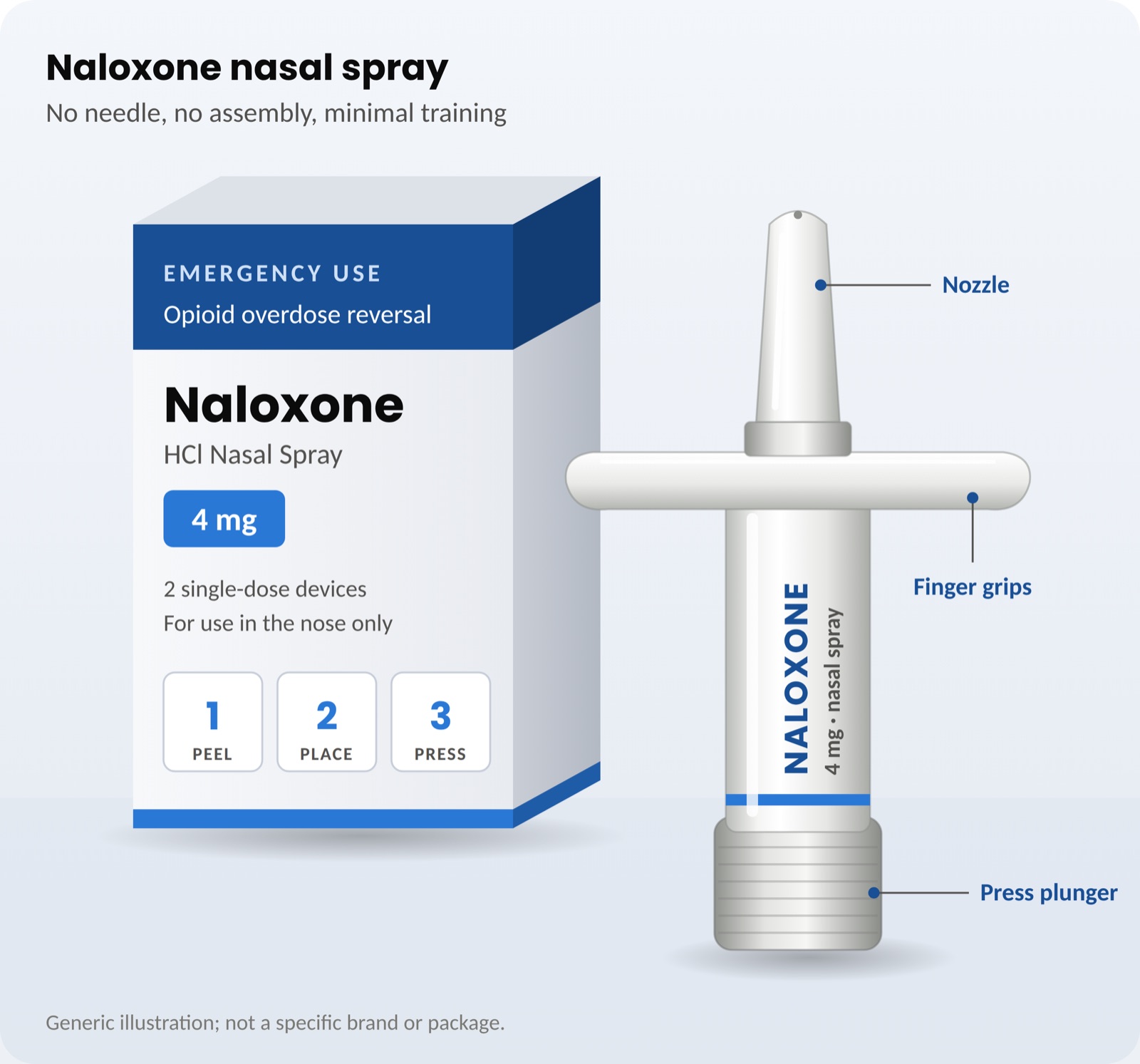
- Stock FDA approved reversal medications. Only two are currently approved: naloxone and nalmefene, available as nasal sprays (no needle, minimal training) or injectables. For most workplaces, the nasal spray is the practical call.
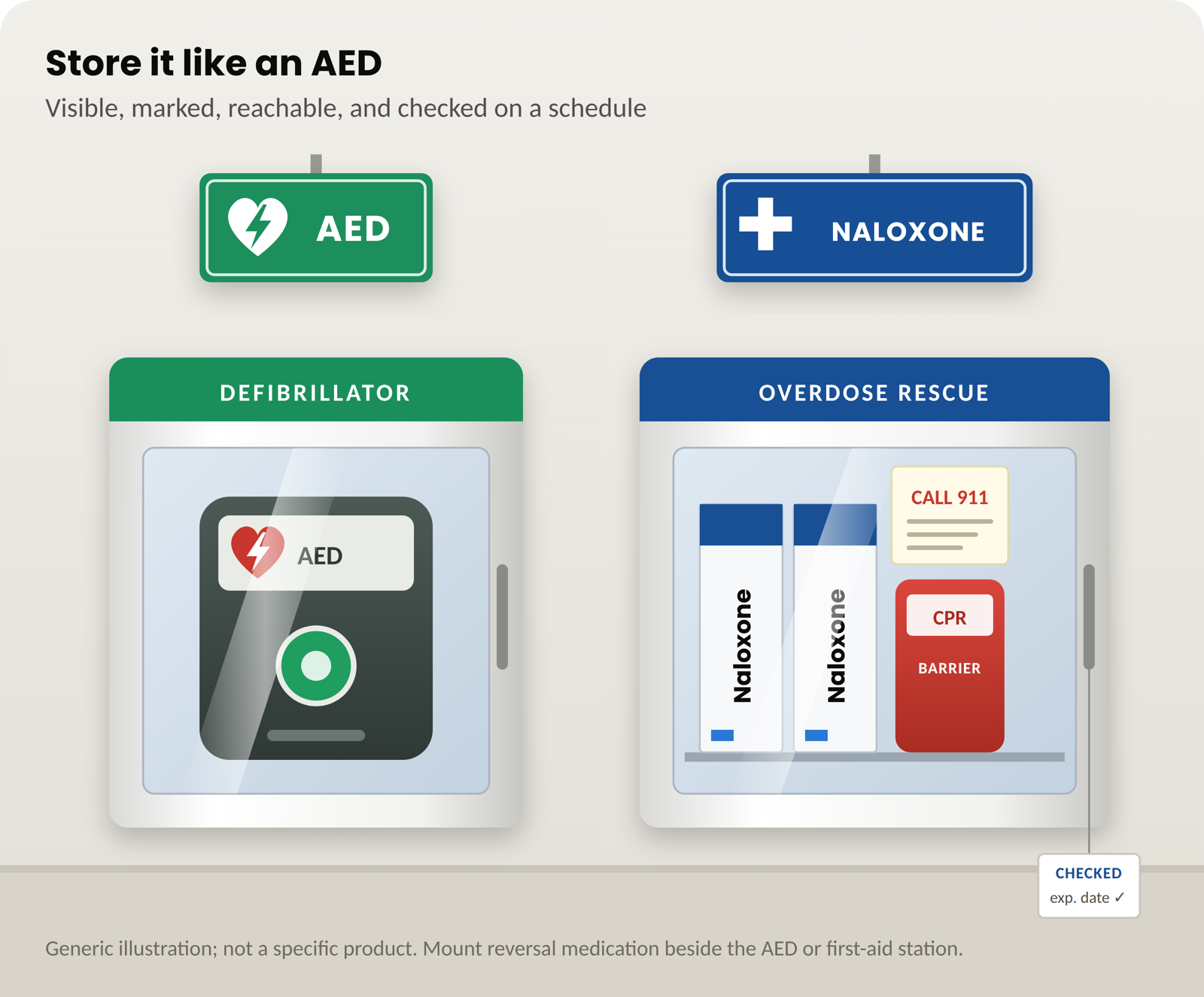
- Treat it like an AED, not a first aid supply buried in a drawer. OSHA drew that comparison on purpose. Reversal medication needs to be visible, marked, and reachable in an emergency, not filed away in a cabinet nobody remembers exists.
- Train workers to recognize an overdose: slowed or stopped breathing, blue tinged lips or fingertips, pinpoint pupils, gurgling or snoring sounds, unresponsiveness, and train them to act before it's too late to matter.
- Call 911 every time, even if the person seems to come around. Reversal medication wears off; the opioid can outlast it, and a second wave of respiratory depression can follow once the medication fades.
- Plan for acquisition and upkeep. Employers can get naloxone through pharmacies (many without a prescription), wholesale distributors, state standing orders, group purchasing organizations, manufacturer programs, or local health departments. Somebody needs to own expiration tracking, the same way somebody already owns your AED battery checks.
- Know your state's Good Samaritan protections, and build them into training so responding employees act instead of hesitating over legal exposure that, in most states, doesn't actually apply to a good faith rescue attempt.
Worth noting: the guidance spends real space on the human side of this, not just the clinical side. Training should cover a respectful approach to overdose situations and a path toward post overdose treatment resources. That's not filler language. Stigma is the single biggest reason overdose response programs never get built, and it's worth telling your leadership plainly: this is a first aid decision, not a judgment on anyone's character.
New York Just Made It Mandatory
New York didn't wait around for a federal standard. Starting December 13, 2026, the state's opioid antagonist law requires covered private sector employers, specifically those already required under OSHA standards to keep first aid supplies on hand because no infirmary or clinic sits close enough to the worksite, to stock an FDA approved opioid antagonist somewhere in the workplace.
A few practical points worth knowing now:
- It doesn't have to sit in every first aid kit. The law only requires the antagonist to be available somewhere in the workplace. A centralized rescue station qualifies, the same way one AED can cover a whole floor instead of a single room.
- Government entities are excluded, but the private sector scope is wide.
- The fine print is still coming. New York's Department of Labor hasn't yet issued regulations covering exact dose counts, placement and storage rules, or training curriculum requirements. Employers have some runway, but it's shorter than it looks: about three months from this writing to the compliance date, and the details are still being written.
California Is Coming Too, Just on a Longer Clock
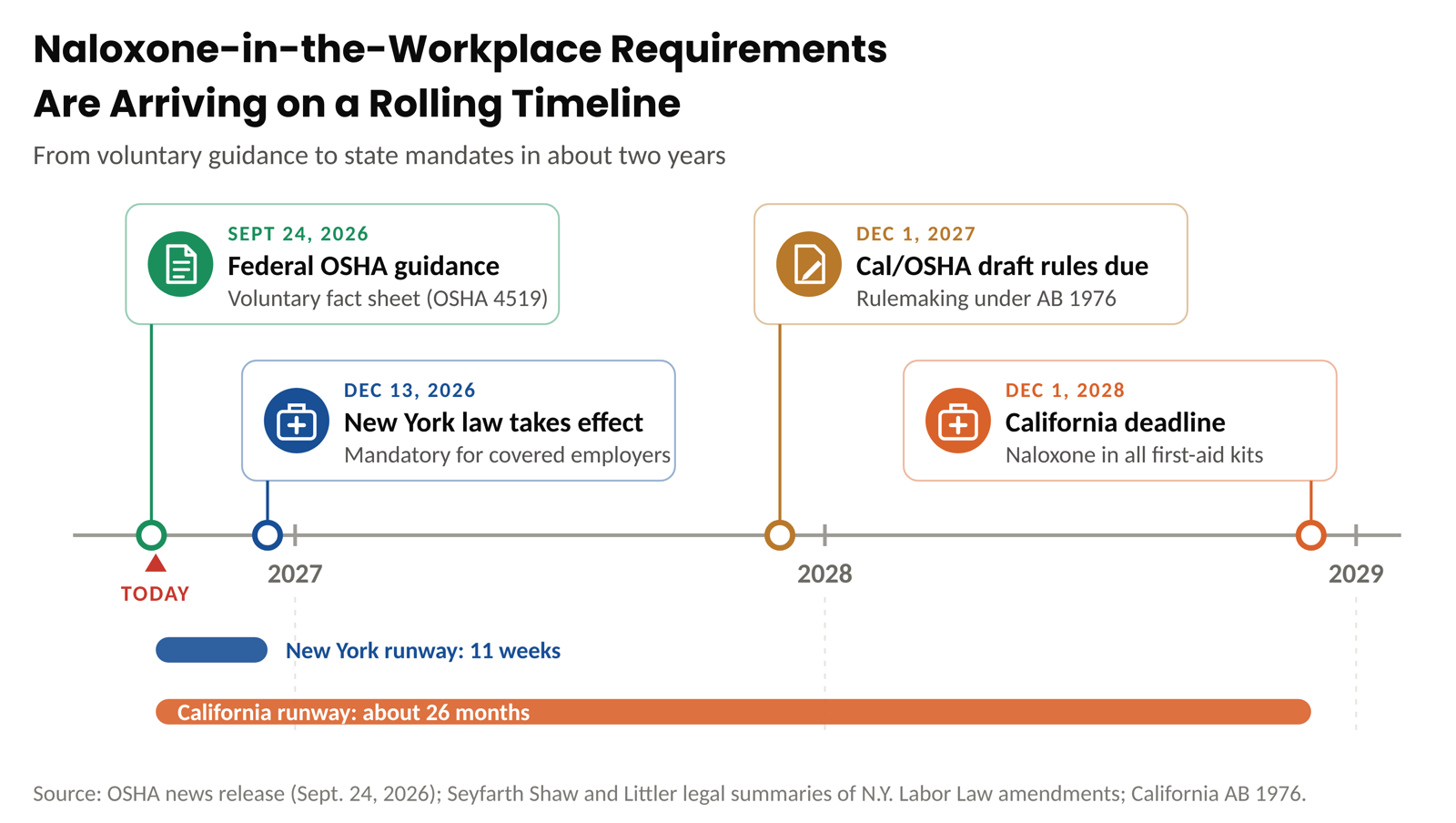
New York isn't an outlier here, it's the first mover. California's AB 1976 will require naloxone or another FDA approved reversal medication in every workplace first aid kit statewide, with Cal/OSHA required to publish draft rulemaking by December 1, 2027, ahead of a December 1, 2028 compliance deadline. The bill's sponsor pointed to a DEA finding that seven out of every ten fentanyl laced pills seized nationally now carry a potentially lethal dose, a number that should settle any argument about whether this is strictly a big city problem or a “certain industries” problem.
Set the federal guidance next to these two state laws, and the pattern isn't hard to read: naloxone is heading toward the same status AEDs reached two decades ago, standard workplace emergency equipment that started as a good idea, became a state requirement in the leading states, and eventually turned into the assumed baseline everywhere. Employers who move early aren't just compliant sooner, they aren't scrambling when their own state's version of this law shows up, because New York and California both make one thing clear: it's a matter of when, not if.
What To Actually Do This Quarter
Skip waiting on New York's regulations or a federal standard to force your hand. Here's a practical build out, whether your state has a mandate yet or not:
- Get reversal medication into your facility now. It's inexpensive, shelf stable for roughly two to three years depending on the product, and easier to acquire than most safety leaders assume.
- Put it where people will actually find it: next to the AED, at the first aid station, somewhere marked and known, not tucked away with the eyewash refill cartridges.
- Fold overdose recognition into your existing first aid and CPR refreshers. You already have a training cadence running; this is an add on, not a new program built from scratch.
- Assign ownership. Somebody already owns your AED pad expiration dates. Hand that same person, or a backup, the naloxone shelf life too.
- Talk to your workforce before you talk to your lawyers. The stigma conversation matters more than the compliance conversation. A program employees are afraid to use, or afraid to trigger because of what a positive drug policy might mean for a coworker, is a program that fails exactly when it's needed most.
- Watch New York's coming regulations and California's 2027 rulemaking, even if you operate somewhere else. They'll likely set the template other states borrow from, the same way heat illness rules have jumped from state to state while OSHA's own federal rule sits parked in limbo.
The Bottom Line
This is a straightforward case of boring compliance now beating a tragic headline later, and that's my favorite kind of problem to fix, because the fix itself is genuinely simple. A naloxone kit costs less than your average toolbox and takes less training time than your annual harassment refresher. What it buys you is a real shot at saving a life in the four to six minute window before EMS can realistically arrive, the same window your AED program already taught you matters enormously.
OSHA handed you the playbook voluntarily. New York just turned it into homework with a due date. Don't be the employer explaining to an investigator, or worse, to a grieving family, why the kit that would have made the difference wasn't on the wall.
Blaine J. Hoffmann has been in the occupational safety & health industry for 30 years and is the author of Rethinking SAFETY Culture and Rethinking SAFETY Communications. Blaine is the producer and host of The SafetyPro Podcast.
Sources: U.S. Department of Labor/OSHA news release and Fact Sheet OSHA 4519, “Opioid Overdose Rescue with Reversal Medications” (Sept. 24, 2026); U.S. Bureau of Labor Statistics, Census of Fatal Occupational Injuries; National Safety Council, Injury Facts; Seyfarth Shaw LLP and Littler Mendelson legal summaries of New York Labor Law amendments (S5922); California AB 1976; U.S. Drug Enforcement Administration.