
Nov 25, 2026
David Keeling Wants OSHA in the Door Before Something Goes Wrong
By Blaine J. Hoffmann, MS OSHM
Someone asked David Keeling what success would look like for OSHA. His answer: OSHA walks up to an employer's door, the door opens, and the people inside say, "OSHA, finally, it's about time you got here." He knows that may be Shangri-La, but it's where he wants OSHA headed.
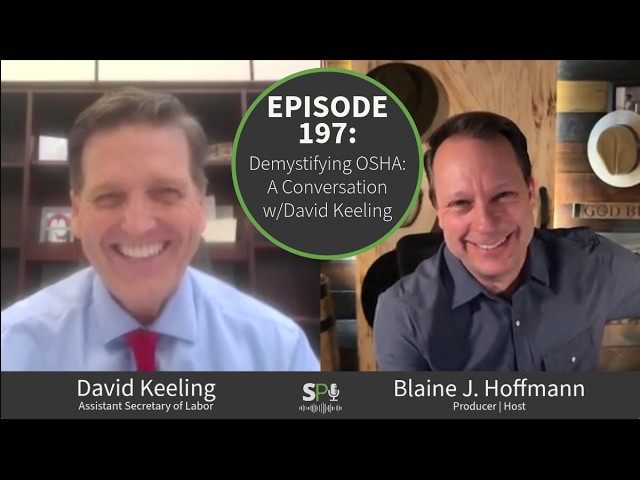
When this episode was recorded, David was about four months into the job as Assistant Secretary of Labor for Occupational Safety and Health, after a 40-year career that included senior safety roles at UPS and Amazon. He joined Blaine J. Hoffmann on Episode 197 of The SafetyPro Podcast to help demystify OSHA for Safety Pros, some of whom never deal with the agency in their whole careers.
Why OSHA wants in the door sooner
"For too many years," David said, "OSHA has been a four-letter word." Most visits come after something has gone wrong, and by then, he said, it's already too late. He wants OSHA to reach employers earlier, through support and collaboration, and meet businesses where they are. He said OSHA's career staff feel the same way. He hears them say they don't want to be the policeman on the beat.
He was clear that OSHA is an enforcement agency and will remain one. "But if all we do is enforce, we're missing a tremendous opportunity." He said he cares a great deal about the number of inspections, because each one is an interaction with employers and employees, and less about the number of citations and fines.
Ask what you learned, not whether you got cited
Back in industry, after any agency visit, from OSHA to the EPA to a local agency, David asked his safety managers and supervisors one question: what did we learn? The answer nearly always came back the same. No citations, no fines, we're doing great.
That wasn't the question, he said.
His phrase for the mindset he wants is "constructively dissatisfied": even when you're doing well, find a way to get better. He said OSHA was looking at leaving something with employers after every interaction, formalizing something many inspectors already do: pointing out ways to lower a job's risk even when there's no legal issue. He sees AI helping with that.
Make the case in the business's terms
Early in his career, David said, he did inspections, reviews and policies, and that was all. He didn't build a business case. Telling people a rule is the law is a low bar, in his view. He'd rather show how working safely supports the business and can set a company apart from its competitors.
He also doesn't believe in a standalone safety culture. Safety can be built into an organization's culture, but the organization's culture will win, so you find a way to win within it. And don't be afraid to ask questions, he said. The further you get from the job as it's being done, the less you know, even if you used to do that job.
What good faith looks like, in his view
Blaine asked what good faith looks like to OSHA in 2026 and beyond. David said he was answering as a safety professional, not an attorney.
People argue about the percentages, he said, but he puts it at about 98 to 2. The 98 want to do the right thing for the right reason and don't know how, or haven't had the chance. Where OSHA finds willful or potentially criminal neglect, he said, it will deal with that harshly, and that approach is not changing.
A self-described terrible golfer, he put it this way: "For me, compliance is like a sand wedge." It gets you out of a spot you don't want to be in. There are a lot of other clubs in the bag, he said, and OSHA hasn't always used them.
Serious injuries at smaller companies, and Safety Champions
David named serious injuries and fatalities (SIF) as a trend where OSHA has an opportunity. He said the numbers show outsized growth in serious injuries, and injuries in general, at small and medium-sized businesses. He also cited the Bureau of Labor Statistics count released shortly before the recording: about 5,070 workplace deaths, of which, he said, fewer than 800 were directly tied to compliance activities OSHA oversees. He pointed to the smallest businesses, which may never interact with OSHA, and to transportation, which he said was the number one cause of workplace deaths. "I can't live or play in a space where OSHA is going to go after 800 fatalities and not 5,070."
For companies that aren't ready for VPP, OSHA's program where sites work toward Star status, he pointed to Safety Champions, which OSHA had recently rolled out. It's aimed at small and medium-sized companies, and at others earlier in their journey, and connects them with safety mentors. He also said OSHA's on-site consultations are walled off from enforcement, acknowledged that people don't believe that, and said OSHA wants to change that perception.
Blaine's name for learning from other companies is safety R&D: rip off and duplicate. David's version is steal shamelessly. At UPS, he said, he and his counterpart at FedEx regularly shared best practices, and it made them both better.
What to take back to your site
- After any agency visit, ask your team "What did we learn?" before anyone says "no citations."
- Make the case for safety in the business's own terms, not only by pointing to the law.
- Go to where the work happens and ask questions. The job has probably changed since you last did it.
- If you're at a smaller company without a full safety program, look into the Safety Champions program David described.
- Borrow what works from other sites, even competitors, and share what works for you.
The full conversation with David covers the mentors who shaped him, how he sees AI changing the work, and Blaine's own first experience with OSHA after a fatality.