
Nov 25, 2026
Critical Thinking in Safety Means Looking Past the Quick Fix
By Blaine J. Hoffmann, MS OSHM
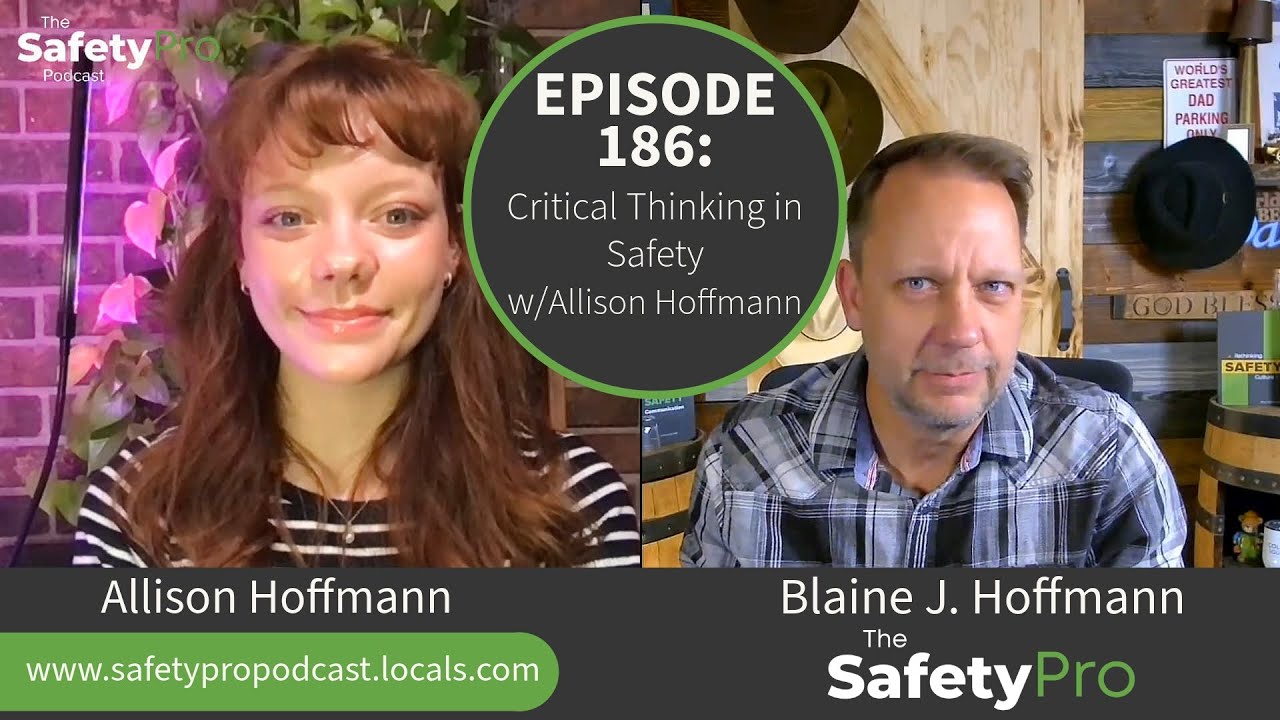
A forklift near miss. Nobody got hurt, and the fix seems to write itself. "So a quick fix would be to retrain the worker or the employee," Allison Hoffmann said. Critical thinking is what makes you look at everything else first.
Allison, Blaine's daughter, was Blaine's guest on Episode 186 of The SafetyPro Podcast. Allison is a preschool teacher and about halfway through an associate's degree in occupational safety and health at Columbia Southern University, and had just taken a class on critical thinking there. It was Allison's first safety podcast.
What critical thinking means in safety
Allison's definition: "critical thinking is the ability to look at a situation objectively and not make assumptions." In safety, Allison said, that means finding the root cause of a problem by looking at all of the factors behind an event, and judging from the facts rather than from fallacies.
The conversation started with investigations, the obvious example, and widened to corrective and preventive actions and designing for safety. Then it turned to confirmation bias: when we have an idea we want to promote, we build every argument around that idea. Blaine said biases like that come into play not just in incident investigations but in other areas of managing safety.
The quick fix is rarely the whole story
Back to the forklift. Allison said a critical look goes beyond the driver's training to other behavior and to the environment: the lighting, the surroundings, even how fast the driver had to work and whether there was a deadline. Consider all of the possible causes instead of singling out one.
Blaine agreed: "We don't make decisions in a vacuum." All kinds of influences drive our decision-making, and what we see from the outside is the behavior.
We expect people at work to be perfect
Blaine pointed to a running joke with colleagues. Outside of work, we're all just people. "For some reason we get to the workplace and automatically we assume everybody is perfect without fault." When a mistake leads to an injury, an illness or property damage, the investigation decides the employee shouldn't have done that, and stops there.
Allison's way around that trap was to skip the surface-level causes and dig into the systems, the processes and human behavior. Keep an open mind, Allison said, and don't let your assumptions guide your conclusions. Blaine added that understanding human behavior is part of critical thinking.
A newcomer's view is worth hearing
Blaine asked how a young Safety Pro can bring critical thinking to a team. By young, Blaine means young in the career. It "has nothing to do with age," and Blaine talks with people the same age who are just getting into safety. Allison thought an outside perspective helps. People come from different backgrounds, cultures and ways of life. If you see someone doing a task a way you wouldn't, Allison said, keep in mind that "they wouldn't think that they would do it your way."
Blaine has always enjoyed working with everyone from engineers to maintenance technicians, because each one sees a problem differently. A Safety Pro's answer can make something safe and still not be workable for the people who do the job. Blaine's advice: always include workers in conversations about solving safety problems. They're the ones who have to do the job, so in that sense they're the customer.
Learning how to think, not what to think
Allison said the most useful part of the classes is learning what applies to real-life scenarios, and then learning to explain it to people who learn differently. Some of the people you'll work with never learned it in a class. "They might have just lived it," Allison said. Allison's classmates include firefighters and police officers, people around 60 and people around 18, some from across the world.
Blaine knows that path: leaving the fire service at 30 to start over in occupational safety and health, finishing a bachelor's degree with an infant at home (Allison), and going straight into a master's program. Blaine doesn't think "non-traditional student" fits anymore, since that route is more common than it used to be.
Allison compared a lecture hall, where Allison heard much the same perspective across the room, with classes built on discussion boards and assignments. Allison finds hearing from all sorts of people a lot more valuable. Blaine remembered lecture halls as places where you get talked to, remember things and get tested on them, instead of explaining how an idea applies to you. They agreed it's hard to imagine being lectured about critical thinking. As one of them asked, "Where's the thinking part of that?"
Allison's ethics class used dilemmas that seemed far-fetched at first, like choosing at a train track between a Mercedes and a baby. Then Allison took out those details and put a workplace in their place: a safety procedure that would hinder efficiency or profit. Which one do you choose?
What to take back to your site
- At your next near miss, look at the lighting, surroundings, pace of work and deadlines before anyone settles on retraining.
- When you think you already know the cause, check whether you're building every argument around that one idea.
- When an investigation reaches "you shouldn't have done that," keep going and ask what else was in play.
- Ask the newest person on your team what looks odd to them.
- Bring the workers who do the job into the conversation before you settle on a fix.
The full conversation with Allison covers Allison's move from a traditional university to discussion-based classes, what Allison has learned from classmates in their second careers, and Blaine's idea for more episodes with people just getting into the profession.